
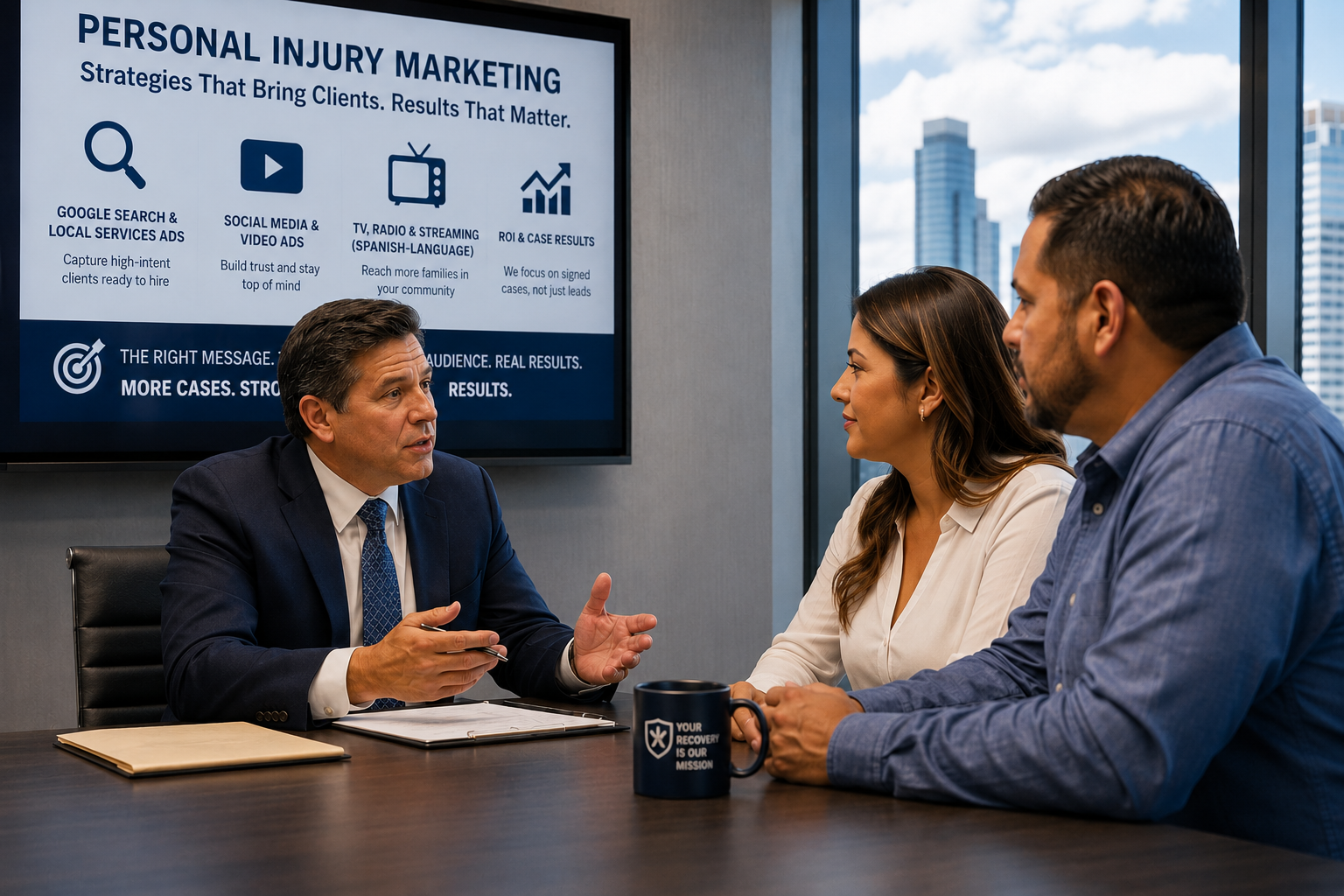
Key Takeaways
- Why do most personal injury lawyer ads fail? Generic messaging and poor audience targeting are the two most common reasons personal injury advertising burns budget without producing signed cases.
- Which channels work best for personal injury lawyer commercials? Google Search and Local Services Ads capture high-intent prospects right now. Social media and video build awareness earlier in the decision cycle. Spanish-language TV, radio, and streaming reach Hispanic audiences at a lower cost per impression than English-language equivalents.
- Does the Hispanic market require a different strategy? Yes. Culturally fluent Spanish-language campaigns consistently outperform translated English ads for reach, trust, and conversion among Spanish-speaking personal injury clients.
- How should ROI be measured? Track cost per signed case, not just cost per lead. Attribution across channels shows which ads are actually driving retained clients.
- What should you look for in a personal injury marketing agency? Legal vertical experience, proven bilingual capabilities, and transparent reporting tied to case acquisition, not clicks or impressions.
Personal injury lawyer marketing is one of the most competitive advertising categories in the United States. Cost-per-click on Google for terms like ‘personal injury attorney’ regularly exceeds $100 in major markets, and firms that run undifferentiated ads rarely see a return that justifies the spend. This guide breaks down what actually works, from the creative decisions inside a personal injury lawyer commercial to the targeting logic behind a paid search campaign, with specific attention to the Hispanic market, where the opportunity is significant and largely underserved.
Why Do Most Personal Injury Lawyer Ads Fail to Convert?
Personal injury lawyer ads fail most often because they look and sound identical to every other firm running in the same market. The problem is not the channel or the budget. It is the strategy behind the campaign.
Generic messaging that blends in
Generic messaging is the single fastest way to make a personal injury ad invisible. When every firm in a market runs copy that says ‘We fight for you’ or ‘No fee unless we win,’ none of them stand out. A prospect scrolling through search results or watching a pre-roll ad has no reason to choose one firm over another if the messaging is identical. The firms that convert leads consistently have a specific point of differentiation in their ads, whether that is a practice focus, a geographic specialty, a track record with a particular type of injury case, or a commitment to a specific community. Vague, feel-good language signals nothing to a prospect who needs to make a fast decision about who to call.
Targeting the wrong audience at the wrong time
Audience targeting mistakes waste more personal injury ad spend than almost any other factor. Running broad keyword campaigns without negative keywords pulls in irrelevant traffic. Targeting demographic segments that are too wide means paying for impressions and clicks from people who have no legal need, no intention to hire an attorney, or who live outside the firm’s service area. Timing matters too. A display ad shown to someone who has not experienced an injury and is not actively searching for legal help is an awareness play, not a conversion play. Firms that confuse brand awareness channels with direct response channels consistently overpay for leads that do not convert to signed cases.
What Channels Work Best for Personal Injury Lawyer Commercials and Paid Ads?
Personal injury lawyer commercials and paid ads perform differently depending on where a prospect is in their decision process. The right channel mix depends on your market, your budget, and whether you are focused on capturing demand that already exists or building awareness with audiences who have not yet searched.
Google Search and Local Services Ads
Google Search campaigns capture personal injury prospects at the highest point of intent, the moment someone types ‘car accident lawyer near me’ or ‘slip and fall attorney in [city].’ These users have already decided they need legal help. They are comparing options. Legal is one of the most expensive industries on Google Ads, with average CPCs well above most other verticals, but the trade-off is that the traffic is qualified. Google’s Local Services Ads (LSAs) operate on a pay-per-lead model rather than pay-per-click, which gives personal injury firms more budget predictability. LSAs also display a ‘Google Screened’ or ‘Google Guaranteed’ badge, which adds a layer of trust that standard search ads do not carry. For firms focused on cost efficiency, LSAs are often the better starting point before scaling into broader paid search campaigns.
Social media ads and video commercials
Social media ads on Facebook, Instagram, and YouTube reach personal injury prospects before they search, which makes them an awareness and retargeting tool rather than a direct conversion channel. Facebook and Instagram allow demographic and interest-based targeting that Google Search does not, so a firm can reach adults in a specific zip code who match the profile of a likely personal injury client. YouTube pre-roll ads function similarly to traditional personal injury lawyer commercials but with far more targeting precision. A 15- or 30-second video ad can be served to users in a specific city, in a specific age bracket, who have recently visited accident-related content. Retargeting campaigns, which serve ads to people who have already visited a firm’s website, consistently produce lower cost-per-lead numbers than cold audience campaigns on social platforms.
Spanish-language TV, radio, and streaming
Spanish-language broadcast and connected TV represent one of the most cost-efficient channels available to personal injury firms targeting Hispanic communities. Hispanic audiences over-index on streaming consumption, and ad inventory on Spanish-language connected TV platforms is priced significantly below comparable English-language inventory. Traditional Spanish-language TV and radio, through networks like Univision and Telemundo, still reach large audiences in high-Hispanic-population markets like Los Angeles, Houston, Miami, Chicago, and New York. For personal injury firms in those markets, a well-produced Spanish-language commercial placed on the right channels can generate a volume of leads that would cost several times more to acquire through English-language paid search. The key is that the creative has to be culturally appropriate, not just linguistically accurate. More on that below.
How Does the Hispanic Market Change Your Personal Injury Marketing Strategy?
The Hispanic market changes personal injury marketing strategy in ways that go beyond language. Hispanic Americans represent more than 19% of the U.S. population, and in major metro markets that share rises significantly. A large portion of that population prefers to consume information and make decisions in Spanish, and many are underserved by law firms that either ignore the market entirely or approach it with a translated English ad and call it done.
Cultural fluency versus direct translation
Cultural fluency in personal injury advertising means creating messaging that reflects how Spanish-speaking communities think about legal situations, family, trust, and authority, not just converting English copy word for word. A translated ad often carries the rhythm, idioms, and assumptions of its original language. It can feel foreign to a native Spanish speaker, and in legal advertising, a message that feels foreign does not build the trust needed to prompt a call. Culturally fluent ads use the right regional dialect, reference familiar situations, and position the attorney in a way that resonates with how Hispanic communities evaluate credibility. As Harlan Schillinger, widely recognized as a pioneer of legal advertising, has noted, if you do not understand the culture, you are not connecting, you are just making noise. You can read more about why stale Spanish-language legal ads are destroying trust with Hispanic clients and what to do instead.
Where Hispanic personal injury clients are searching
Hispanic personal injury clients are active across a range of platforms, and the mix differs from the general market. Hispanic adults in the U.S. use Facebook and YouTube at high rates, and WhatsApp is a primary communication tool in many communities. Spanish-language Google searches for legal terms are significant and growing, and the competition for those keywords is lower than for their English equivalents, which means lower CPCs for firms willing to run bilingual paid search campaigns. For a deeper look at platform-specific data, the Hispanic social media usage breakdown on this site covers where these audiences spend their time and what that means for ad placement decisions. Spanish-language streaming, connected TV, and radio round out the channel mix for firms running full-funnel campaigns targeting this audience.
What Makes a Personal Injury Lawyer Commercial Actually Work?
A personal injury lawyer commercial works when it gives a prospect a clear reason to call, a reason to trust, and a specific action to take, all within a short window of attention. Most commercials fail on at least one of those three counts.
A clear, specific call to action
A vague call to action is one of the most common conversion killers in personal injury advertising. ‘Call us today’ tells a prospect nothing they did not already know. A specific call to action tells them exactly what to do, what to expect, and why now. Examples that work: ‘Call [number] for a free case review. We answer 24 hours a day.’ or ‘Text [number] right now and a bilingual attorney will call you back within the hour.’ The more specific and low-friction the prompt, the more likely a prospect is to follow through. In Spanish-language personal injury commercials, the call to action also needs to account for the fact that some prospects may be hesitant to call if they are concerned about language barriers. Explicitly stating that the firm has Spanish-speaking staff removes that friction and increases call volume.
Social proof and case outcomes
Social proof in personal injury advertising builds the trust that moves a hesitant prospect to pick up the phone. Client testimonials, specific settlement amounts (where permitted by state bar rules), and case outcome statements all signal that the firm has a track record. A commercial that says ‘We recovered $1.2 million for a client injured in a truck accident’ is more persuasive than one that says ‘We get results.’ For Spanish-language commercials, testimonials from clients who share the same cultural background as the target audience carry additional weight. A Spanish-speaking client describing their experience in their own words, in their own dialect, is more credible to a Spanish-speaking prospect than a translated testimonial. Always confirm that any case result or testimonial used in advertising complies with your state bar’s rules on attorney advertising before running the spot.
How Do You Measure ROI on Personal Injury Advertising?
ROI measurement on personal injury advertising requires tracking beyond the click. The metrics that matter are the ones tied to revenue, not traffic.
Cost per lead versus cost per signed case
Cost per lead is a surface metric. A campaign that generates 200 leads at $50 each looks efficient until you find out that only three of those leads became signed cases. Cost per signed case is the number that reflects actual business performance. To calculate it, you need intake data connected to your ad data. That means your intake team needs to log the source of every call, form submission, and text, and that data needs to feed back into your campaign reporting. Firms that track cost per signed case by channel can make budget decisions based on what is actually producing revenue. Firms that only track cost per lead often shift budget toward channels that look cheap but convert poorly. For more on improving the intake side of this equation, the best practices in bilingual intake resource covers how to handle Spanish-speaking leads in a way that maximizes sign rates.
Attribution across multiple channels
Attribution in personal injury marketing is complicated because most clients touch multiple channels before calling. A prospect might see a Spanish-language TV commercial, search for the firm’s name on Google, click a paid search ad, and then call from the website. If you attribute that case only to the last click, you undervalue the TV commercial that started the process. Multi-touch attribution models give a more accurate picture of which channels are contributing to signed cases. At a minimum, firms should use call tracking numbers specific to each channel, UTM parameters on all digital ads, and a CRM that logs intake source at the case level. Connecting ad platform data to intake and case management data is the only way to know which channels are earning their budget. The speed matters: why law firms need fast response to lead forms piece is also relevant here, because response time is one of the biggest variables affecting whether a tracked lead converts to a signed case.
What Should You Look for in a Personal Injury Marketing Agency?
Choosing a personal injury marketing agency is a business decision, and the criteria should reflect what actually drives case acquisition, not what looks good in a pitch deck.
Legal market experience and vertical focus
Legal market experience matters because personal injury advertising has specific compliance requirements, competitive dynamics, and conversion patterns that generalist agencies do not understand. An agency that has spent years running campaigns in other industries will have a learning curve that costs you money. Agencies that focus on legal marketing, specifically personal injury, understand that the buying cycle for a legal client is different from an e-commerce purchase, that intake quality directly affects conversion, and that ad copy has to thread the needle between persuasive and compliant. Ask any agency you are evaluating for case studies specific to personal injury, not just general legal marketing. Ask for cost per signed case data, not just cost per lead. If they cannot produce that data, they are not measuring the right things.
Bilingual capabilities and Hispanic market expertise
Bilingual marketing competency in personal injury advertising goes beyond having a Spanish speaker on staff. Genuine capability means native-level fluency in the dialects spoken by the target community, experience producing Spanish-language creative that converts, knowledge of the media channels where Hispanic personal injury clients are reachable, and an understanding of the cultural context that makes messaging land. For firms in markets with significant Hispanic populations, this is not a nice-to-have. It is a direct revenue opportunity. According to ABOGADOS NOW’s work with more than 450 firms nationwide, Spanish-language campaigns regularly produce qualified personal injury leads at a lower cost than comparable English-language campaigns, because the competition for those prospects is lower and the messaging resonates more directly. If you are evaluating whether your current English ads are costing more than they should, the data at your legal English ads are 3x more expensive makes the case clearly.
FAQ: Personal Injury Lawyer Ads and Marketing
How much should a personal injury law firm spend on advertising?
Personal injury advertising budgets vary widely depending on market size, competition, and practice focus. In smaller markets, a firm might generate a steady case pipeline with $5,000 to $10,000 per month in paid media. In competitive markets like Los Angeles, New York, or Miami, meaningful paid search presence can require $30,000 to $100,000 or more per month. The right number is not a fixed percentage of revenue but a function of your target cost per signed case and the volume of cases you want to acquire. Start by calculating what a signed case is worth to your firm, then work backward from a target cost per acquisition to determine what budget is justified. Spanish-language campaigns in high-Hispanic-population markets often allow firms to enter at lower budget thresholds because CPCs and CPMs are lower than their English-language equivalents.
Are personal injury lawyer commercials still effective?
Personal injury lawyer commercials remain effective, particularly for building brand recognition in a local market and for reaching audiences who are not actively searching yet. Traditional TV has declined in overall viewership, but connected TV and streaming have filled much of that gap, and Spanish-language streaming in particular has grown significantly. A well-produced commercial on the right platform still drives inbound call volume. The firms that get the most from commercials treat them as part of a broader funnel, using the commercial to build awareness and then capturing that demand through paid search when prospects search for the firm by name or by practice area.
What is the best platform for personal injury lawyer ads?
Google Search and Local Services Ads consistently produce the highest-quality personal injury leads for direct response campaigns because the prospect is actively searching for legal help at the moment the ad appears. For firms targeting Spanish-speaking communities, adding a Spanish-language paid search campaign and Spanish-language social media ads on Facebook and YouTube typically produces strong results at a lower cost per lead than English-language campaigns in the same market. The best platform depends on your goals: Google for immediate, high-intent demand; social and video for awareness and retargeting; Spanish-language broadcast and streaming for volume reach in Hispanic markets.
How long does it take for personal injury marketing to produce results?
Paid search and Local Services Ads can produce inbound leads within days of launching a campaign, though optimizing to a target cost per signed case typically takes 60 to 90 days of data collection and adjustment. Spanish-language paid media campaigns follow a similar timeline. SEO-driven strategies take longer, usually six to 12 months before organic traffic produces a consistent case pipeline, but the cost per lead from organic search is lower over time. Firms that need cases quickly should start with paid media and build their organic presence in parallel.
Do personal injury firms need a separate Spanish-language ad campaign?
Yes. A standalone Spanish-language campaign consistently outperforms a translated version of an English campaign. The reasons are practical: keyword behavior differs between English and Spanish searches, the platforms and placements where Spanish-speaking audiences are most active differ from the general market, and messaging that is culturally appropriate performs better than a direct translation. Running a separate campaign also allows you to optimize budget, bidding, and creative independently for each audience. Firms that fold Spanish-language ads into their English campaigns as an afterthought typically see lower conversion rates and higher cost per lead from their Spanish-speaking prospects. For guidance on running effective Spanish-language paid search without a bilingual team in-house, see how to run Google Ads for Hispanic clients without speaking Spanish.
What compliance rules apply to personal injury lawyer advertising?
Personal injury lawyer advertising is regulated at the state level by each state’s bar association, and rules vary significantly. Common requirements include disclosures on case results (such as noting that past results do not guarantee future outcomes), restrictions on the use of the word ‘specialist’ unless the attorney holds a certified specialization, rules around client testimonials, and in some states, mandatory filing or pre-approval of advertising materials. States like Florida, Texas, and California have detailed attorney advertising rules that apply to digital ads, TV commercials, and social media. Before running any personal injury ad campaign, review your state bar’s advertising rules and confirm that all creative, including Spanish-language materials, meets those requirements. Working with an agency that has experience in legal advertising compliance reduces this risk significantly. For a recent example of how advertising compliance is tightening, the California SB 37 update on misleading legal marketing is worth reviewing.